Kyrgyzstan (/ˌkɜːrɡɪˈstɑːn/ KUR-gih-STAHN;[8]Kyrgyz: Кыргызстан Kırğızstan (Kyrgyz pronunciation: [qɯrʁɯsˈstɑn])), officially the Kyrgyz Republic (Kyrgyz: Кыргыз Республикасы, romanized: Kırğız Respublikası; Russian: Кыргызская Республика, tr. Kırgızskaya Respublika), and also known as Kirghizia (Russian: Киргизия[kʲɪrˈɡʲizʲɪjə]),[9] is a country in Central Asia.[10]Kyrgyzstan is a landlocked country with mountainous terrain. It is bordered by Kazakhstan to the north, Uzbekistan to the west and southwest, Tajikistan to the southwest and China to the east. Its capitaland largest city is Bishkek.
Kyrgyz Republic
Кыргыз Республикасы (Kyrgyz)
Kırğız Respublikası
Кыргызская Республика (Russian)
Kyrgyzskaya Respublika
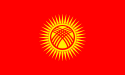
Flag

Emblem
Anthem: Кыргыз Республикасынын Мамлекеттик Гимни
Kırğız Respublikasının Mamlekettik Gimni
"National Anthem of the Kyrgyz Republic"
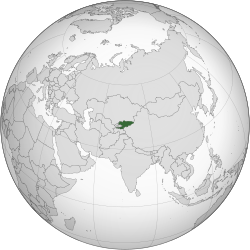
Location of Kyrgyzstan (green)
Capital
and largest city
Bishkek
42°52′N 74°36′EOfficial languages
Kyrgyz (official state language)
(2019[3])
14.7% Uzbek
5.5% Russian
1.1% Dungan
5.2% Other
Religion
82.7% Islam
16.0% Christianity
1.3% others
Demonym(s)Kyrgyzstani;[4] KyrgyzGovernmentUnitary parliamentaryconstitutional republic
Dastan JumabekovLegislatureJoğorqu KeñeşIndependence from the Soviet Union
14 October 1924
5 December 1936
• Independence declared
31 August 1991
21 December 1991
• Recognized
25 December 1991
• Admitted to theUnited Nations
2 March 1992
27 June 2010Area
• Total
199,951 km2(77,202 sq mi) (85th)
• Water (%)
3.6Population
• 2019 estimate
• 2009 census
5,362,800
• Density
27.4/km2 (71.0/sq mi) (176th)GDP (PPP)2018 estimate
• Total
• Per capita
$3,812[5] (147th)GDP (nominal)2018 estimate
• Total
• Per capita
$1,254[5] (157th)Gini (2017)27.3[6]
lowHDI (2017) 0.672[7]
medium · 122thCurrencySom (c) (KGS)Time zoneUTC+6 (KGT)Driving siderightCalling code+996ISO 3166 codeKGInternet TLD.kg
Kyrgyzstan's recorded history spans over 2,000 years, encompassing a variety of cultures and empires. Although geographically isolated by its highly mountainous terrain, which has helped preserve its ancient culture, Kyrgyzstan has been at the crossroads of several great civilizations as part of the Silk Road and other commercial and cultural routes. Though long inhabited by a succession of independent tribes and clans, Kyrgyzstan has periodically fallen under foreign domination and attained sovereignty as a nation-state only after the breakup of the Soviet Union in 1991.
Since independence, the sovereign state has officially been a unitary parliamentary republic, although it continues to endure ethnic conflicts,[11][12] revolts,[13] economic troubles,[14][15] transitional governments[16]and political conflict.[17] Kyrgyzstan is a member of the Commonwealth of Independent States, the Eurasian Economic Union, the Collective Security Treaty Organization, the Shanghai Cooperation Organisation, the Organisation of Islamic Cooperation, the Turkic Council, the Türksoycommunity and the United Nations.
Ethnic Kyrgyz make up the majority of the country's 6 million people, followed by significant minorities of Uzbeks and Russians. Kyrgyz is closely related to other Turkic languages, although Russian remains widely spoken and is an official language, a legacy of a century of Russification. The majority of the population are non-denominational Muslims.[18] In addition to its Turkic origins, Kyrgyz culture bears elements of Persian, Mongolian, and Russian influence.


.svg)